Turning Olive Waste into Value
Innovating for a Circular and Sustainable Mediterranean
Join the forum
Your Voice Matters in the Circular Transition
Join the conversation. Share ideas. Shape the future of olive sustainability.
OLIWA Project: Giving New Life to Olive Waste
Repurposing olive by-products for a sustainable Mediterranean
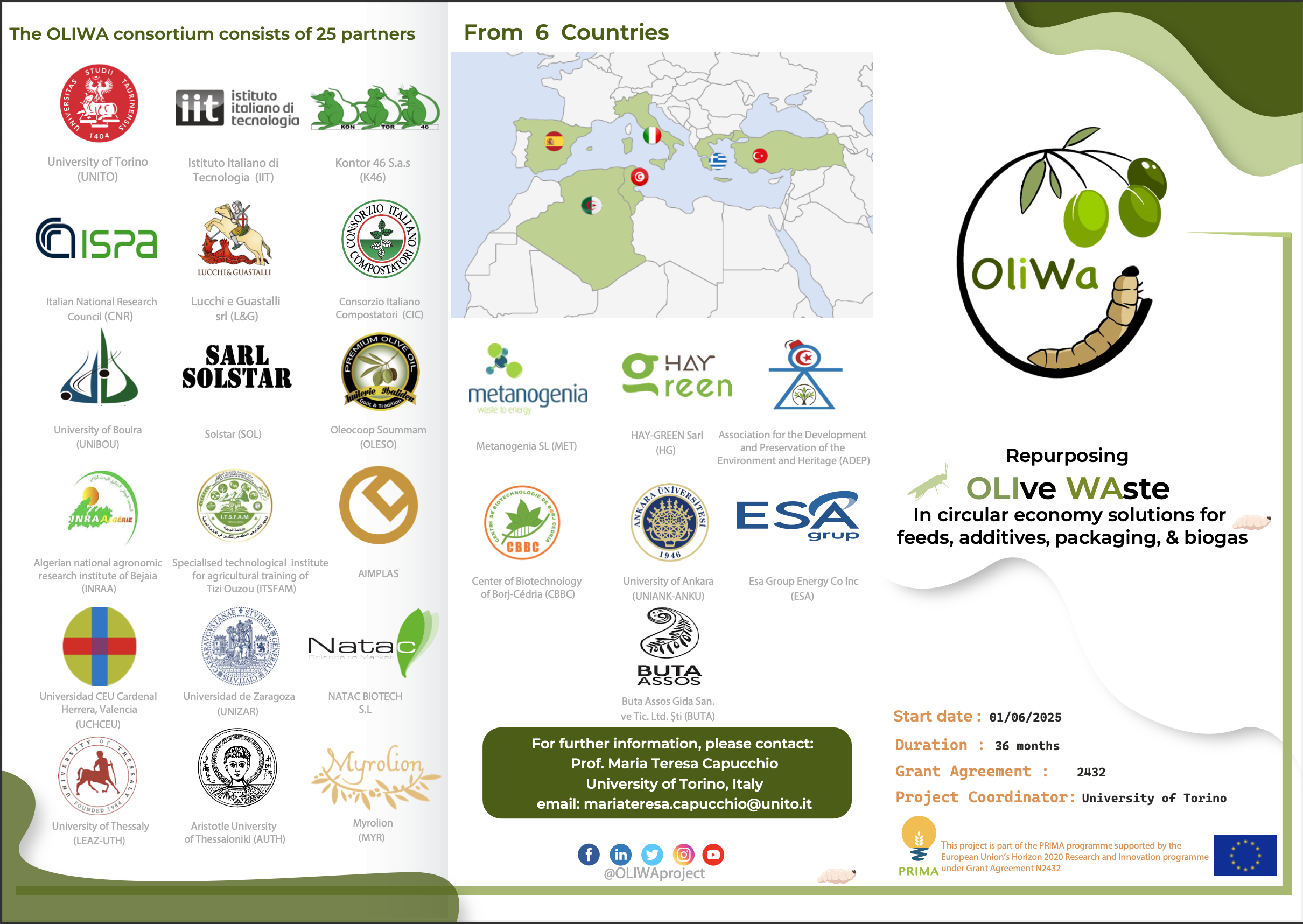
OLIWA (Repurposing OLIve WAste in circular economy solutions for feeds, additives, packaging, and biogas) is an international research project supported by the European Union’s Horizon 2020 programme through PRIMA. Coordinated by the University of Torino, OLIWA unites 25 partners from 6 Mediterranean countries—Italy, Spain, Greece, Turkey, Algeria, and Tunisia—to turn olive waste into valuable products through innovative circular economy solutions.
Key Objectives
OLIWA aims to revolutionize the olive industry by reducing waste and creating sustainable value chains using olive by-products. The project promotes a zero-waste circular economy and seeks to cut food loss and waste by at least 25%
Innovative Use of Olive Waste
Development of insect-based animal feed using olive by-products
Extraction of functional ingredients and natural additives for food and feed
Sustainable Packaging Solutions
Creation of eco-friendly packaging materials from olive and insect-derived substances to reduce food spoilage
Green Energy from Waste
Biogas production from olive residues and insect/animal manure to promote clean energy alternatives
🎯 Specific Objectives (SO1-SO12)
SO1: Olive By-products in Insect Rearing
To explore OB’s role in insect rearing; evaluating insect meal quality, waste reduction, and sustainability.
SO2: In-vitro Testing of Olive Natural Extracts and Insect Meals
To investigate the effects of olive NE, insect meals and their association by means of in-vitro testing.
SO3: Animal Model Testing for Antioxidant Effects
To investigate the effects of olive NE on animal models (ApoE KO mice) to evaluate their antioxidant effects.
SO4: Olive Natural Extracts as Feed Additives
To investigate and demonstrate the use of the olive NE as feed additives for poultry and fish farming.
SO5: Insect Meal as Animal Feed
To investigate and demonstrate the use of insect meal as feed for poultry and fish farming, and evaluate the sustainability of this solution.
SO6: Enhanced Animal Health and Product Quality
To enhance animal health and product quality through NE/insect incorporation into poultry and fish diets.
SO7: Food Packaging Development
To investigate OB’s potential in food packaging to enhance preservation and minimise food losses.
SO8: Biogas Production
To investigate incorporation of animal and insect manure as well as OBs for biogas production.
SO9: Sustainability Assessment
To assess the sustainability of the novel processes and products, and circular repurposing model, in the Water-Energy-Food-Ecosystem (WEFE) Nexus approach through Life Cycle Assessment (LCA), Environmental Footprint (EFP) evaluation, and a local level WEFE framework.
SO10: Stakeholder Engagement
To enhance stakeholder interactions through a Multi-stakeholder approach and an online ICT platform, engaging stakeholders in the olive oil local value chain and the poultry/fish supply chain.
SO11: Business Model Development
To produce a business model for the OBs for each demonstration local value chain, to facilitate adoption by farmers and stakeholders, thus fostering the growth of the circular economy.
SO12: Engagement and Dissemination
To implement successful engagement (MSA), dissemination-communication activities and training classes to enhance the capacity of farmers, smallholders, and the supply chain with at least 50% of women trainees, to effectively adopt OLIWA solutions. Additionally, to collaborate with other cognate projects in sundry activities, providing joint policy recommendations to reduce barriers and promote accessibility. To implement the FAIR and open science and data principles.
Latest News
OLIWA Project at the “Game of Research” in Turin! 🇮🇹
We are thrilled to share that the OLIWA Project was prominently featured at the first edition of the "Game of Research", an inspiring scientific event organized by the Istituto Zooprofilattico Sperimentale (IZS) di Piemonte, Liguria e Valle d'Aosta in Torino, Italy....
OLIWA Policy Brief #1: Safe Circular Pathways for Olive By-Products, Insect-Based Feed and Bio-Based Materials

OLIWA’s June European Tour: Driving the Circular Bioeconomy Across Three Major Events
The first week of June marks a massive scale-up in the dissemination of the OLIWA Project. In a coordinated demonstration of scientific and institutional impact, our consortium members will simultaneously deploy across three major European events from June 9th to June...
Our Network


🤝 Join Us in the Change
Collaborate for a Greener Mediterranean Future
The OLIWA project is more than research—it’s a shared mission to build a circular, sustainable future for the Mediterranean region. We believe that collaboration across disciplines, sectors, and borders is key to real change.
Whether you’re a researcher, entrepreneur, policy-maker, or part of a civil society organization, your contribution can amplify our impact.
We welcome partnerships that help us:
-
Expand the reuse of agro-industrial by-products
-
Co-develop eco-innovations in packaging, feed, and energy
-
Scale sustainable practices across Mediterranean communities
-
Share knowledge and promote responsible consumption
🌱 Together, we can close the loop—turning waste into value and challenges into opportunities.